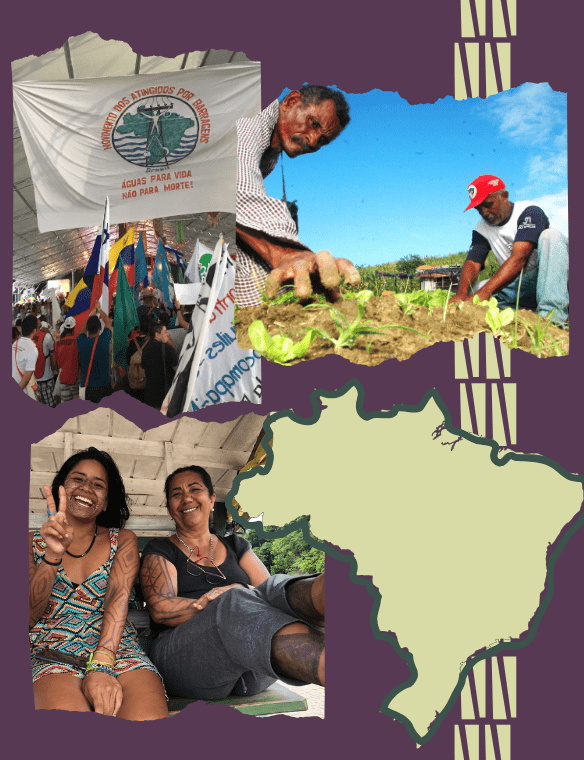
Brazil
Troubled Waters
February 2nd, 2010

Harmony Foundation releases new educational presentation, Troubled Waters
Harmony Foundation of Canada recently released a new educational presentation, entitled Troubled Waters. This 27 minute, narrated multimedia presentation examines freshwater issues of global importance and inspires local action through examples of grassroots leaders working to protect and conserve fresh water in communities around the world.
Grassroots International's program coordinator for Brazil &Mesoamerica, Saulo Araújo worked with the Harmony Foundation to helphighlight the One Million Cisterns Project in Brazil, begun with seed support by Grassroots International for its partner Pólo Sindical.
Family Farmers Feed Brazil

The Brazilian Institute of Geography and Statistics (IBGE) recently published a report on the country’s agricultural sector. The last report had been published in 1996. The new document supports several points raised by peasant organizations, such as our partner the Via Campesina International, around the critical role of the small scale agriculture to climate justice and hunger. The main points are outlined below.
[Cassava] Bread and Roses: Brazilian Farmers Seek a Dignified Life

During our visit to Brazil earlier this month, Saulo Araujo and I met with Grassroots International’s partners and the communities in which they work. I had prepared myself to talk about a range of issues, from Creole seeds to water scarcity to land occupation. I hadn’t expected to hear so much about the importance of a dignified life.
Land Reform Under Lula
By Chris Tilly, Marie Kennedy and Tarso Luís Ramos
July 20th, 2009

The Landless Workers’ Movement (MST) of Brazil, which has mobilized more than a million Brazilians to occupy and farm large landholdings, was cautiously optimistic when Luiz Inácio “Lula” da Silva of the Workers Party won the presidency in 2002. “We campaign for Lula,” remarked MST organizer Jonas da Silva (no relation) during the campaign, “even though we are critical of him for shaping his discourse for the middle class.” In the country with perhaps the most unequal land distribution in the world, electing a pro-worker, pro-poor president marked a potential turning point.
But as Lula finishes up his second term (new presidential elections take place in October 2010), the MST’s assessment is grim. Land redistribution has stagnated, the government continues to b
Sugar Cane Invades the Brazilian Central Plateau
When plans for a Grassroots International site visit to Brazil suddenly included my name last winter, I was thrilled. Oh boy! I could visit with our partners in country and learn directly from them their struggles, their hopes. I told Saulo Araujo, Grassroots’ Coordinator for Mesoamerica and Brazil (and my to-be traveling companion) that I wanted to talk to the people who ultimately benefit from Grassroots’ funding.
Saulo listened well, I realized the first time I saw the itinerary he pulled together—no office visits to be found. Instead, we were scheduled to visit encampments, settlements, and various on-the-ground projects.
From Seed Sovereignty to Food Sovereignty: The MCP's Creole Seeds Project
A partner of Grassroots International, the Popular Peasant Movement (MCP) has been conducting trials to identify and produce the best local seeds. The Creole Seeds Project, as it is known, plays a vital role in reaching out to farmers who are being lured in by the promises of agrobusiness.
“The Creole Seeds Project is a great project because the community wants to see it to believe it. They can see the results for themselves—that our local seeds are more productive, insect resistant and produce better tasting crops than hybrids or other seeds,” said Elias Freitas Mesquita, MCP’s regional coordinator.
He added, “The seed project is like a magnet that attracts the farmers, who then build more alliances.”
A Movement for the Land, and for Dignity
Along with Saulo Araujo, Grassroots International’s Program Coordinator for Mesoamerica and Brazil, I just visited the central region of Brazil, about three hours outside the capital of Brasilia.
And the women of the Central Cerrado have gone nuts. Or, to be more precise, they have begun to process and sell Baru nuts.
These members of the Popular Peasant Movement (MPC) in Goias, Brazil, began to package their food as a collective factory with more than a dozen women (and a few men).
14 Brazilian Activists Freed After Protesting Mega-Dam Project

Our colleagues in the Brazilian Movement of People Displaced by Dams (MAB) just sent some wonderful news that I want to share with you. After a week of intense work gathering support from Brazilian and international organizations, 14 MAB members are now free, although another four still remain in jail.
The original group of 18 activists was arrested for demonstrating on behalf of families displaced by the Tucuruí Dam in the Amazon region. The group of peasant families called on the Brazilian government to stop the mega-dam project and instead provide infrastructure projects--such as roads, schools and health clinics--and to open lines of credit for agriculture and fishing farming.
Brazilian Activist from MST Participates in the Brooklyn Food Conference
The Food Sovereignty movement in the United States is well and alive. And thanks to the work of food cooperatives, community supported agriculture (CSA) and local farmers, little by little more neighborhoods and cities are joining this social movement that is reclaiming the right to quality food.
This past weekend, the movement's strengthen was displayed in Brooklyn, NY, where over 2,000 people met in one of the largest U.S. events for Food Sovereignty this year.
Participants in the Brooklyn Food Conference represented different places and backgrounds in the U.S. food movement. Event speakers included some of the leading voices in the United States, such as social activist Malik Yakini from Detroit, and Raj Patel, the author of Stuffed and Starved.