
Building a Movement-Led Agrarian Reform for the 21st Century
Photos source: IPC for Food Sovereignty via Facebook

Colombia Hosts a Global Gathering on Agrarian Reform and Rural Development
The International Conference on Agrarian Reform and Rural Development (ICARRD) has long played a key role in much broader struggles for land, water, and territory. While the conference itself marked an important moment for social movements, their work inside, outside, and in parallel to the official space was carefully calculated as part of the intersecting politics of food sovereignty and ecological justice. In February, twenty years after the first ICARRD in Porto Alegre, Brazil, ICARRD+20 took place in Cartagena, Colombia. Grassroots International was there to support our movement partners in renewed efforts towards re-centering agrarian reform within global land and food politics.
In the lead-up to the official conference, we joined social movements and academics in parallel, somewhat overlapping, spaces, which played a critical role in shaping the political direction of the event. Placing particular emphasis on the social movement forum enabled us to support our movement partners as they aligned positions, consolidated demands, and strengthened collective analysis which was then brought forward to the official proceedings.
Historical Snapshots and the First Iteration of ICARRD
Around the turn of the millennium and at the height of neoliberal globalization, many states, corporations, and big philanthropic organizations were discussing what to do about land. There were two dominant proposals on the table: First, promoting land tenure security but without any elements that would lead towards justice and sovereignty. This essentially formalizes existing inequalities by guaranteeing security for big business (and philanthropy), ensuring that peasants and Indigenous Peoples would continue to be dispossessed. Second is a system based on petty reform, meaning that everyone gets land but big capital gets more land than the people who work and steward it – and gets it much faster.
Social movements have long rejected these so-called land reform proposals and were actively setting their own agenda. La Via Campesina, for instance, initiated its Global Campaign for a Comprehensive Agrarian Reform in 1999 (more recently adapted to be the Global Campaign for Agrarian Reform, Land, Water, and Territory), and Grassroots International has been supporting it for about just as long. They subsequently linked land reform and food sovereignty at their conference in Bangalore in 2000.
The first ICARRD was hosted by the Brazilian government and involved our partner Movimento de Trabalhadores Rurais Sem Terra/ Landless Workers Movement (MST), who were coordinating globally with La Vía Campesina. To make sure that government and corporate actors didn’t dominate the process, movements organized a parallel forum for Land, Territory, and Dignity. An articulation of the territorial aspect of land vs. land as a mere financial resource was one of the biggest achievements coming out of that first ICARRD. This contributed to the political momentum, led by Indigenous movements, toward passage of the UN Declaration on the Rights of Indigenous Peoples (UNDRIP) the following year in 2007, spelling out the connection between Indigenous Peoples and territory.
The 2007-08 polycrisis, followed by a period of reform at the UN Committee on World Food Security (CFS), then made it possible for movements to use much of what they had discussed parallel to ICARRD as the architecture for the Tenure Guidelines on the Governance of Forests, Fisheries, and Farmlands adopted by the CFS. This legislation was a massive win for social movements.
In the following years, movements navigated a technical, yet voluntary, state-driven terrain, while confronting an intensified rush to grab land globally, together with increasing authoritarianism, pandemic, and genocide. The number of people with insecure tenure swelled to over a billion, while movements fought to implement UNDRIP and advocate for and win passage of the UN Declaration on the Rights of Peasants and Other Peoples Working in Rural Areas (UNDROP). All of this set the stage for the renewed push for ICARRD+20 this year.

Standouts of ICARRD+20
ICARRD+20 was convened by the Government of Colombia, with support from Brazil and technical backing from the UN Food and Agriculture Organization (FAO). More than 4,000 people attended. Critically, the conference was the result of sustained pressure and mobilization by social movements, particularly through the International Planning Committee for Food Sovereignty (IPC) and Colombian organizations. This significantly shaped the political dynamics of the space.
Unlike the first ICARRD, where movements were largely positioned as external “stakeholders,” ICARRD+20 saw social movements take a central role. Movement participants stressed that the conference must deliver concrete outcomes, particularly in relation to redistributive agrarian reform, land concentration, and corporate land grabbing. They also emphasized the need to address the structural exclusion of women, youth, and rural communities, while calling for stronger recognition of customary and collective tenure systems, enforcement of Indigenous rights to Free, Prior and Informed Consent (FPIC), and more robust implementation of existing frameworks such as the above-mentioned Tenure Guidelines.
Discussions throughout the conference underscored the multidimensional impacts of land inequality. Concentrated land ownership weakens rural livelihoods, deepens poverty, and fuels social and political tensions. These dynamics are further intensified by climate-related policies and investments, such as carbon markets, conservation initiatives, and renewable energy projects, which often proceed without secure land rights for local communities. As a result, participants strongly affirmed that climate justice is inseparable from agrarian justice.
The conference also highlighted the importance of strengthening multilateral cooperation and protecting inclusive global governance frameworks in a context of increasing geopolitical fragmentation. Participants argued that land governance must be integrated into broader global agendas on climate change, biodiversity, and desertification to ensure coherence and accountability. Ensuring equitable access to land and secure tenure and territory rights was recognized as essential to addressing interconnected global crises.
Despite the strong participation and clear political positioning of social movements, the outcomes of the official conference revealed significant tensions. The official ICARRD+20 declaration was negotiated among member states outside the plenary process and was not formally adopted during the conference. While Colombia reportedly sought additional endorsements after the event, social movements did not support the declaration. They argued, among other things, that it lacked ambition regarding redistributive agrarian reform, provided weak recognition of customary and collective tenure systems, failed to guarantee robust protections for Indigenous and community rights, and lacked binding commitments to address land concentration and corporate land grabbing.
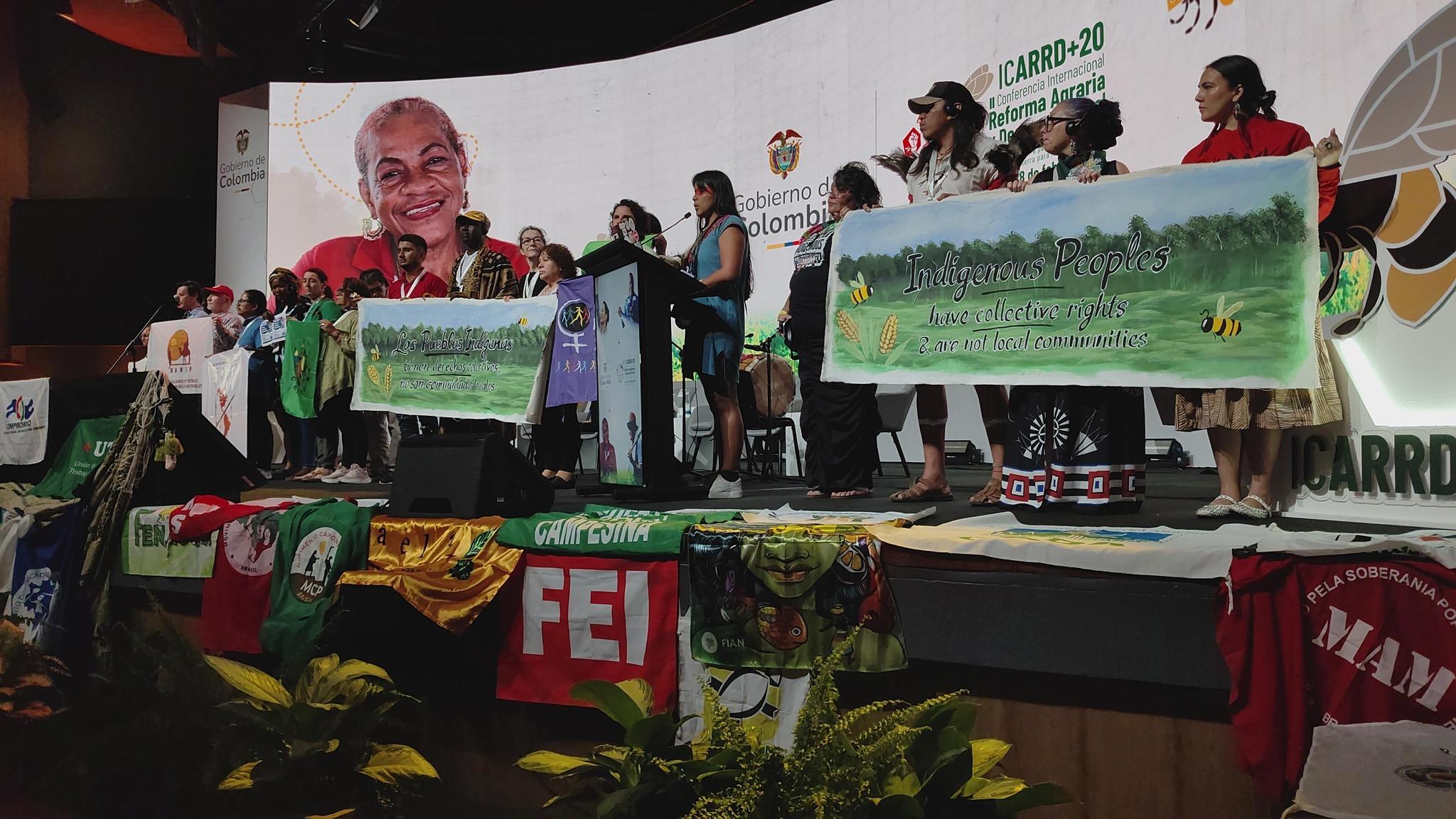
Social Movements Define the Way Forward
In response, social movements issued their own political declaration, which provides a clearer articulation of their collective vision and demands. This united call to action, based on internationalist solidarity, puts defense of territory at the heart of the agenda – clearly weaving together the relationships between land, water, forests, seeds. Encapsulated throughout are the principles of food sovereignty, grassroots feminisms, agroecology, and climate justice.
But what does a just agrarian reform actually look like in the 21st century? Led by the International Planning Committee for Food Sovereignty, social movements advocated for the 4Rs, a framework focused on recognition, redistribution, restitution (and repair), and regulation.
- Recognition is about the legal and political validation of land tenure systems that exist beyond the models of private property. Here, social movements demand recognition of collective and customary land rights – many of them Indigenous systems predating capitalism.
- Redistribution then seeks to break up extreme land concentration by actively transferring territory to those who work the land. This doesn’t only have to do with soil, but is rather a more wholesale change of hands of power, wealth, and decision-making.
- Restitution (and reparation) are complementary processes addressing historical and ongoing dispossession by means of colonization, militarization, and corporate/state land grabbing. Social movements are clear that restitution must include reparations for harms done and the settlement of “historical debts” to Indigenous Peoples. Indeed, redistribution without restitution fails to address the roots of modern land conflict.
- Regulation, finally, involves state interventions to limit the power of market forces and corporations over land and resources. To make this a reality, movements call for definancialization of land and the installation of binding caps, or land ceilings, to rein in agribusiness.
Movements are clear that these 4Rs must work together, as opposing forces have used them separately to pit peoples against one another – peasants seeking redistribution vs. Indigenous peoples seeking recognition, for instance. This refusal of divide and rule tactics through demanding their own multifaceted alternatives is some of the most exciting political work emerging from social movements and the broader convergences they shepherd today.


